
Introduction
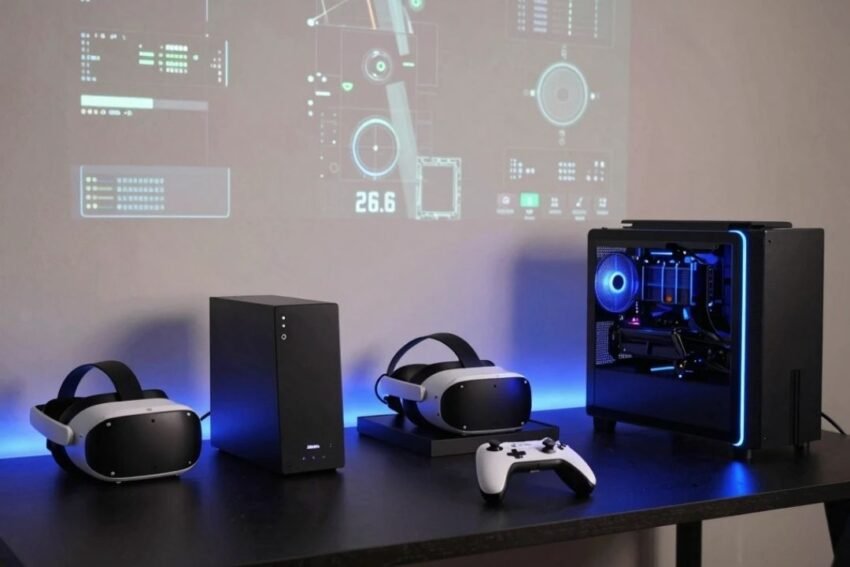
The gaming industry is entering a new era of technological innovation. Video games have evolved from simple entertainment into highly sophisticated digital experiences powered by advanced hardware, artificial intelligence, cloud computing, virtual reality, high-speed networking, and powerful graphics technologies.
In 2026, gaming technology trends are changing how games are developed, played, streamed, and experienced. Artificial intelligence is helping developers create smarter characters and automate parts of game development. Virtual reality and mixed reality are creating immersive experiences, while cloud gaming is making it possible to access demanding games across a wider range of devices.
At the same time, gaming PCs, consoles, handhelds, smartphones, displays, controllers, and audio systems continue to improve.
This article explores the top gaming technology trends in 2026, including AI, VR, cloud gaming, advanced graphics, handheld gaming, 5G, haptics, game development, and the future of interactive entertainment.
What Is Gaming Technology?
Gaming technology includes the hardware, software, networks, platforms, and digital tools used to create and play video games.
It covers technologies such as:
- Gaming PCs
- Consoles
- Graphics processors
- Gaming monitors
- Controllers
- Handheld gaming devices
- Smartphones
- Virtual reality
- Augmented reality
- Cloud gaming
- Artificial intelligence
- Game engines
- Online networking
Together, these technologies determine how games look, perform, and feel.
Why Gaming Technology Is Changing
Gamers expect increasingly sophisticated experiences.
Modern players want:
- Realistic graphics
- Fast loading
- Smooth frame rates
- Intelligent NPCs
- Immersive sound
- Responsive controls
- Large open worlds
- Multiplayer connectivity
- Portable gaming
- Personalized experiences
Technology companies and game developers are responding by investing in faster hardware, smarter software, better networking, and new interaction methods.
Top Gaming Technology Trends in 2026
1. Artificial Intelligence in Gaming
Artificial intelligence is one of the biggest gaming technology trends in 2026.
AI can influence both game development and gameplay.
Developers can use AI to assist with:
- NPC behavior
- Game testing
- Animation
- Dialogue
- Content generation
- Player personalization
- Bug detection
AI-powered systems can make game environments more dynamic by allowing characters to respond to player actions.
Instead of relying entirely on predetermined scripts, future NPCs may be able to react to changing situations more naturally.
2. Generative AI for Game Development
Generative AI is becoming an increasingly important development tool.
It can assist developers with certain creative and technical tasks, including:
- Concept development
- Code assistance
- Dialogue drafts
- Asset creation
- Texture ideas
- Prototyping
- Testing
Generative AI can potentially reduce the time needed for repetitive tasks, allowing developers to focus more on design and creativity.
However, professional oversight remains important because AI-generated content can contain errors, inconsistencies, or unwanted similarities to existing work.
3. AI-Powered NPCs
Non-player characters are a major part of many games.
Traditional NPCs often operate according to predefined behaviors.
AI can make NPCs more responsive by allowing them to react to:
- Player decisions
- Environmental changes
- Combat situations
- Game events
- Dialogue
Smarter NPCs could make game worlds feel more dynamic and unpredictable.
4. Advanced Graphics Technology
Graphics technology continues to advance rapidly.
Modern GPUs can render highly detailed environments with sophisticated lighting, shadows, reflections, and textures.
Advanced graphics can create:
- More realistic characters
- Detailed environments
- Dynamic lighting
- Realistic reflections
- Improved visual effects
As hardware improves, developers can create increasingly complex virtual worlds.
5. Ray Tracing
Ray tracing is an important graphics technology that simulates the behavior of light.
It can improve:
- Reflections
- Shadows
- Lighting
- Global illumination
Ray tracing can make environments look more realistic, although it can also require substantial graphics-processing power.
6. AI-Assisted Upscaling
AI-assisted upscaling technologies can reconstruct higher-resolution images from lower-resolution rendered frames.
This can help gamers achieve a balance between:
- Image quality
- Resolution
- Frame rate
- Performance
It is particularly useful when gamers want high-resolution gaming without requiring the GPU to render every pixel at native resolution.
7. Cloud Gaming
Cloud gaming allows games to run on remote servers while the player’s device receives a streamed video and sends control inputs back to the server.
Potential benefits include:
- Less dependence on local hardware
- Access across supported devices
- Reduced installation requirements
- Centralized server hardware
However, cloud gaming depends heavily on network speed, latency, service availability, and server capacity.
8. 5G and Low-Latency Gaming
Faster mobile networks are creating new possibilities for gaming.
Low-latency connections can be useful for:
- Cloud gaming
- Mobile multiplayer
- Game streaming
- Competitive gaming
- Remote gaming
As network infrastructure develops, players may have more opportunities to access demanding games through mobile devices.
9. Virtual Reality Gaming
Virtual reality provides an immersive gaming environment by placing players inside a digitally generated world.
VR systems can use:
- Headsets
- Motion tracking
- Controllers
- Spatial audio
VR can be especially effective for simulation, adventure, fitness, exploration, and interactive experiences.
10. Augmented Reality Gaming
Augmented reality overlays digital content onto the physical environment.
Instead of completely replacing the real world, AR adds digital objects or information to it.
Potential gaming applications include:
- Location-based games
- Interactive environments
- Multiplayer experiences
- Educational gaming
- Fitness applications
11. Mixed Reality
Mixed reality combines physical and digital environments.
It can allow virtual objects to interact with real-world spaces.
As mixed-reality hardware becomes more capable, developers may create new forms of gaming that blend physical environments with digital gameplay.
12. Advanced Gaming Handhelds
Portable gaming devices are becoming increasingly powerful.
Modern handhelds can provide:
- High-resolution displays
- Powerful processors
- Advanced graphics
- Fast storage
- Wireless connectivity
This allows players to enjoy sophisticated games without being tied to a desktop or television.
13. Gaming Smartphones
Smartphones are becoming increasingly capable gaming platforms.
Gaming-focused smartphones may include:
- High-refresh-rate displays
- Powerful processors
- Advanced cooling
- Large batteries
- Gaming software
- High-performance graphics
Mobile gaming continues to expand the accessibility of gaming technology.
14. High-Refresh-Rate Displays
High-refresh-rate gaming monitors can provide smoother motion and more responsive visual feedback.
Displays with refresh rates such as 144Hz or higher are popular among competitive gamers when paired with hardware capable of producing suitable frame rates.
Other important display technologies include:
- OLED
- HDR
- Adaptive synchronization
- Low response time
- High resolution
15. OLED Gaming Displays
OLED displays offer individually controlled pixels, enabling strong contrast and deep blacks.
For gaming, OLED technology can provide:
- Excellent contrast
- Fast response
- High image quality
- Immersive visuals
OLED gaming monitors and televisions are becoming increasingly attractive for players who prioritize visual quality.
16. Advanced Gaming Audio
Audio plays an important role in immersion.
Modern gaming audio technologies can create spatial sound that helps players identify the direction and distance of sounds.
This can be useful for:
- Competitive gaming
- Horror games
- Open-world games
- Action games
- VR experiences
Better audio can make virtual environments feel more realistic.
17. Haptic Feedback
Haptic technology allows gaming devices to provide physical feedback.
Advanced haptics can simulate:
- Impacts
- Vibrations
- Environmental effects
- Resistance
- Different surfaces
This technology can make interactions feel more physical and immersive.
18. Adaptive Controllers
Modern gaming controllers increasingly include advanced features.
These may include:
- Adaptive triggers
- Motion sensors
- Haptic feedback
- Custom buttons
- Wireless connectivity
Controllers are becoming more sophisticated tools for interacting with digital worlds.
19. Gaming Accessibility Technology
Accessibility is becoming an increasingly important part of gaming development.
Features can include:
- Remappable controls
- Subtitles
- Color customization
- Adjustable difficulty
- Assistive controllers
- Audio descriptions
- Custom input options
Improved accessibility can make gaming available to a wider range of players.
20. Faster SSD Storage
Fast solid-state storage is now an important part of modern gaming systems.
High-speed storage can improve:
- Loading times
- Asset streaming
- Game installation
- System responsiveness
Large open-world games can benefit from fast storage because they often need to load large amounts of environmental data.
21. Cross-Platform Gaming
Cross-platform gaming allows players on different supported devices to play together.
It can connect players across:
- PCs
- Consoles
- Smartphones
- Other supported platforms
Cross-platform technology can make multiplayer communities larger and give players greater flexibility.
22. Game Streaming and Content Creation
Gaming and online content creation continue to become more connected.
Streamers and creators use technology for:
- Live broadcasting
- Video recording
- Screen capture
- Audio production
- Audience interaction
Better hardware and faster internet connections can improve the quality of gaming content.
23. Esports Technology
Competitive gaming depends heavily on advanced technology.
Professional players often prioritize:
- Low-latency displays
- High-performance hardware
- Responsive peripherals
- Stable networks
- Accurate audio
- Reliable software
Small differences in performance and responsiveness can matter in competitive environments.
24. Anti-Cheat Technology
Online competitive games need effective anti-cheat systems.
Developers can combine different approaches to identify suspicious activity.
These may include:
- Server-side analysis
- Software detection
- Behavioral monitoring
- Automated reporting
The goal is to maintain fair gameplay while protecting legitimate players.
25. Game Engine Innovation
Game engines provide developers with tools for building interactive experiences.
They can support:
- Rendering
- Physics
- Animation
- Audio
- Artificial intelligence
- Networking
- Development workflows
As game engines become more advanced, developers can build larger and more detailed game worlds.
Gaming Technology and Personalization
AI and data analytics can help games adapt to individual players.
Potential applications include:
- Difficulty adjustment
- Recommendations
- Personalized challenges
- Player behavior analysis
- Dynamic content
Personalization can make gaming experiences more relevant, although developers must consider privacy and responsible data use.
Benefits of New Gaming Technology
Better Visual Quality
Modern graphics hardware and rendering technologies can create realistic environments.
Greater Immersion
VR, spatial audio, haptics, and advanced displays can create deeper gaming experiences.
Faster Performance
Powerful processors, GPUs, and SSDs can improve responsiveness and loading times.
Greater Accessibility
Custom controls and accessibility options can allow more people to play.
Portability
Handheld devices and smartphones allow gamers to play in more locations.
Smarter Gameplay
AI can make characters and environments more responsive.
Challenges of Gaming Technology
High Hardware Costs
Advanced gaming systems can be expensive.
Hardware Requirements
Some games require powerful hardware to achieve high graphical settings and frame rates.
Internet Dependence
Cloud gaming and online multiplayer require reliable network connections.
Privacy Concerns
Connected games can collect information about players and their behavior.
Security Risks
Gaming accounts can be targeted through phishing, credential theft, and other cyber threats.
AI-Generated Content Concerns
AI-assisted development can raise questions about quality, originality, copyright, and creative ownership.
How to Choose Gaming Technology in 2026
Choosing gaming technology depends on individual needs.
For Competitive Gamers
Prioritize:
- High refresh rate
- Low latency
- Responsive peripherals
- Stable internet
- High frame rates
For Visual Quality
Consider:
- Powerful GPU
- High-resolution display
- OLED
- HDR
- Ray tracing support
For Portable Gaming
Consider:
- Handheld gaming PCs
- Gaming smartphones
- Battery life
- Device weight
- Storage
For VR Gaming
Consider:
- VR headset
- Motion tracking
- Controllers
- Compatible hardware
- Available game library
Future of Gaming Technology
The next generation of gaming technology will likely focus on creating more immersive, intelligent, connected, and accessible experiences.
Smarter AI
AI may produce more responsive characters and dynamic environments.
Better VR and AR
Improved hardware may make immersive gaming more comfortable and realistic.
Stronger Cloud Gaming
Improved networks and infrastructure could make cloud gaming more responsive.
Advanced Haptics
Future controllers and wearable devices may provide more detailed physical feedback.
More Powerful Handhelds
Portable gaming hardware is likely to continue improving in performance and efficiency.
AI-Assisted Personalization
Games may increasingly adapt their experiences to individual players.
Gaming Technology Career Opportunities
The growth of gaming technology is creating opportunities in:
- Game programming
- Game design
- AI development
- 3D modeling
- Animation
- Technical art
- Game testing
- Network engineering
- Cybersecurity
- Audio production
- Game production
Learning programming, graphics, AI, software engineering, and digital design can help prepare people for careers in this industry.
Frequently Asked Questions
What are the biggest gaming technology trends in 2026?
Major trends include artificial intelligence, generative AI, advanced graphics, cloud gaming, VR, AR, powerful handhelds, high-refresh-rate displays, haptics, and faster networking.
How is AI changing gaming?
AI can assist with NPC behavior, development, testing, personalization, animation, dialogue, and other game-development processes.
Is cloud gaming the future?
Cloud gaming has significant potential, but its success depends on network quality, latency, infrastructure, and service availability.
Is VR still important for gaming?
Yes. VR remains an important area of gaming technology, especially for immersive experiences, simulations, fitness, and interactive entertainment.
Why are SSDs important for gaming?
Fast SSDs can reduce loading times and help games stream large amounts of data more efficiently.
Are handheld gaming devices becoming more powerful?
Yes. Modern handheld devices continue to improve in processing performance, graphics capability, storage, display quality, and battery efficiency.
Conclusion
The top gaming technology trends in 2026 demonstrate how rapidly the gaming industry is evolving. Artificial intelligence, generative AI, advanced graphics, cloud gaming, virtual reality, augmented reality, faster networking, powerful handhelds, OLED displays, haptic feedback, and high-speed storage are changing the gaming experience.
AI is becoming particularly important because it can assist developers and create more dynamic gameplay. Meanwhile, VR and mixed reality are opening new possibilities for immersive entertainment. Cloud gaming and faster networks are making game access more flexible, while handheld devices are bringing powerful gaming experiences into portable formats.
The future of gaming technology will likely focus on smarter gameplay, deeper immersion, faster performance, greater accessibility, and more personalized experiences.
For gamers, the best technology depends on individual needs. Competitive players may prioritize high refresh rates and low latency, while enthusiasts may prefer advanced graphics and OLED displays. Portable gamers may choose handheld systems, while VR enthusiasts may focus on immersive hardware.
As technology continues to advance, gaming will become increasingly connected to AI, cloud computing, advanced graphics, and immersive interfaces. These innovations are likely to make video games more interactive and sophisticated while creating new opportunities for developers, players, creators, and the wider gaming industry.